
ALL RESEARCH
16:13OCT 16
Breaking the Bottleneck: A Plan to Boost DAO Throughput on Arbitrum
16:10OCT 15
The Future of DAOs: A UK Perspective
The UK Law Commission—an institution typically concerned with the likes of land laws and company regulations—turned its attention to something seemingly far outside its wheelhouse: DAOs.
In decentralized governance, every few years brings a pivotal moment where ideas leap from the shadows of speculation into the spotlight of legitimacy. July 2024 marked one of those moments. The UK Law Commission—an institution typically concerned with land laws and company regulations—turned its attention to something seemingly far outside its wheelhouse: Decentralized Autonomous Organizations (DAOs) (p. 1).
It was an unexpected move, especially for a body representing a country known for its conservative legal framework. But here we are, standing at the intersection of centuries-old lawmaking and cutting-edge technology. The Commission’s release of a 289-page paper on DAOs signals something important. This is no longer a passing trend—DAOs are now taken seriously in the highest legal corridors (p. 3).

Why does this matter? It’s not every day that a centuries-old legal system grapples with an entirely new kind of entity. The Law Commission’s report is a careful dance between tradition and innovation. On the one hand, it explores the long-established principles of business law: incorporation, liability, and governance (pp. 44-48). On the other, it recognizes the radical nature of DAOs, organizations that exist primarily in code, without centralized control, potentially autonomous, and operating across borders without clear jurisdiction (p. 34).
When the Commission first approached this topic, it was tasked with a simple but profound question: What are DAOs, and how do they fit into the law? (p. 1). Every jurisdiction around the world is trying to answer this question. Some have tried to create entirely new rules to accommodate DAOs. Others, like the UK, are attempting to tweak existing legal frameworks to fit this digital-first entity. And this is where the story gets interesting.
To understand the Commission’s paper, we need to go back to the origins of DAOs. They weren’t just a new business model—they were born from an ideal, an idea that organizations didn’t have to operate the way they had for centuries. No more boards of directors making decisions behind closed doors. No more centralized power structures. Instead, DAOs emerged as a way to decentralize control, to let communities govern themselves, and, in many cases, to let smart contracts—pieces of code—run things on autopilot (p. 9).
The Commission got this. They seemed almost enchanted by the promise of decentralization. They nailed the common philosophical goals of DAOs: transparency, decision-making power dispersed across participants, and the absence of a single point of failure (p. 16). They recognized that in a DAO, a participant in New York could have just as much say as one in Tokyo. They also appreciated how this digital-first approach could potentially eliminate human-run organizations’ inefficiencies—and sometimes corruption.
But, and it’s a big but, the Commission didn’t shy away from acknowledging the messiness of reality. As much as “autonomous” implies a sleek, self-running machine, many DAOs today are neither fully decentralized nor fully autonomous. Some rely on core teams of developers to keep things running, while others still involve plenty of manual human intervention when smart contracts fall short (p. 48). The paper tackled this head-on, pointing out the ambiguity that has come to define the space.
What happens when an organization calls itself a DAO but doesn’t fit the original ideal of decentralization? This is where the Commission delves into the meat of the issue: the blurred lines between “true” DAOs and hybrid arrangements (p. 83). Many DAOs today are hybrids, existing between the decentralized, code-driven vision of the future and the practical realities of today.
A key takeaway from the paper is the notion of hybrid arrangements. These DAOs combine on-chain operations—like voting and governance—with off-chain legal structures. In other words, they use the benefits of blockchain technology while still wrapping themselves in the safety of traditional legal frameworks (p. 83). It’s the best of both worlds, and becoming the model many DAOs are adopting. Why? While decentralization is a powerful ideal, legal clarity and protection from liability are often just as important.
In a way, hybrid DAOs might be the bridge that allows these new organizations to move from niche internet communities into the mainstream. Using legal wrappers like Limited Liability Companies (LLCs) or foundations, DAOs can provide their members with the legal protections traditional businesses have enjoyed for centuries (p. 83). This creates a more accountable and transparent structure while retaining the core ethos of decentralized governance.
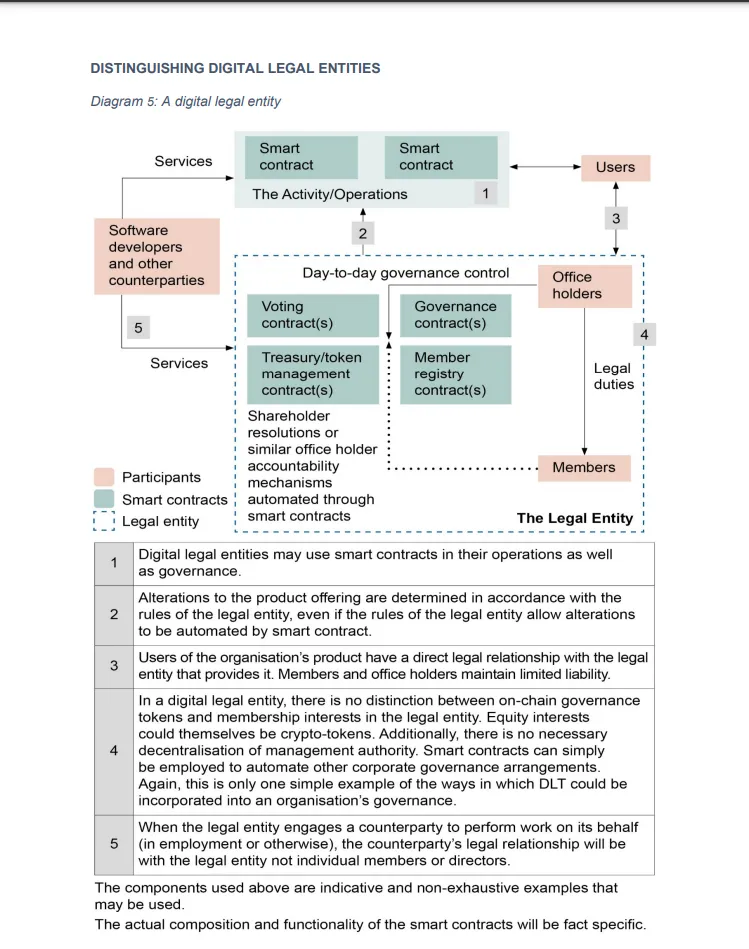
The report points out that legal wrappers are essential for many DAOs who want to do business in the real world. The Commission even highlighted the inevitability of this trend. As DAOs continue to grow and scale, they must interact with existing legal systems, which means adopting legal structures that ensure their operations comply with tax laws, employment regulations, and financial reporting requirements (p. 154).
Think of it this way: A DAO might want to operate purely on-chain, without any ties to the legal world. But as soon as it wants to buy a physical asset, sign a lease, or hire employees, it steps into the jurisdiction of national laws. Without legal wrappers, DAOs could be left exposed—potentially putting their members at risk for personal liability. So, while decentralization remains a powerful concept, many DAOs realize that some form of centralization—at least in terms of legal structure—is a necessary compromise.
The paper suggests that England and Wales could become an attractive jurisdiction for DAOs, not because they plan to overhaul their legal system radically but because the flexibility of common law allows for adaptation (p. 146). The UK’s approach is pragmatic. Rather than creating a new legal entity for DAOs, they propose modifying existing structures to better suit decentralized organizations’ needs (p. 159).
The Law Commission floated the idea of developing a “DAO-specific” legal entity, but they stopped short of making any formal recommendations (p. 7). Instead, they point to the potential for England and Wales to lead in providing legal clarity for DAOs, making it easier for them to operate within a robust legal framework. It balances maintaining the UK’s longstanding legal traditions and embracing the innovation that DAOs represent.
One area where the Commission provided much-needed clarity was around financial regulation and tax. DAOs, particularly those operating in the DeFi space, interact with complex financial systems, and the Commission clarified that regulatory oversight is unavoidable (p. 169). Whether through Know Your Customer (KYC) requirements or anti-money laundering (AML) rules, DAOs must ensure compliance with financial regulations to operate legally.
Taxation is another issue that DAOs must face. The paper dives deep into how tax rules apply to DAOs, particularly regarding income generation, treasury management, and crypto-token distributions (p. 200). The takeaway? While DAOs can try to operate outside traditional systems, the taxman will always have a say. DAOs with significant on-chain activity may need to prepare for interactions with tax authorities, mainly as their treasuries grow and their operations become more complex.
So, what’s next for DAOs in the UK? The Law Commission’s paper doesn’t provide all the answers but opens the door to a future where DAOs are more than just a niche experiment. The UK is positioning itself as a leader in DAO regulation, offering a stable legal environment where DAOs can thrive, grow, and innovate (p. 146).
This is a crucial moment for those of us in the DAO space. The paper serves as a reminder that while DAOs are revolutionary, they are not above the law. And that’s not necessarily a bad thing. Legal clarity will help DAOs gain the trust of mainstream investors, governments, and the broader public. It will also provide much-needed stability as DAOs navigate the complex world of global finance, governance, and regulation.
At Boardroom, we’re keeping a close eye on these developments. The future of decentralized governance is being shaped right now, and we’re committed to helping DAOs and other decentralized projects navigate this rapidly evolving landscape. The UK Law Commission’s report is a critical step forward, and we’re excited to see where it leads.