
Promoting the Contribution for Data Analysis for Achieving Better Public Goods Funding
Abstract
We are conducting research and development aimed at achieving more effective public goods funding mechanisms by quantitatively comparing various crypto grants models. Previous research has highlighted differences in funding distribution methods across grants programs, suggesting that a diverse approach may be necessary to effectively support a range of projects. We seek contributions to continue performing a deeper quantitative analysis of grants programs.
Latest research: https://research.fracton.ventures/reports/a-retrospective-quantitative-review-of-crypto-grants-programs/
Background
Public goods often suffer from underfunding due to the free-rider problem, necessitating intervention by third parties like the government to ensure their adequate provision in traditional economics. Grants programs are crucial for supporting public goods, which are essential for achieving a positive-sum state in the crypto ecosystem. In the crypto space, these programs are generally well-operated, providing vital funding for various projects. However, while individual analyses and reviews of grants programs are common, there is a scarcity of comparative studies that analyze multiple grants programs side by side.
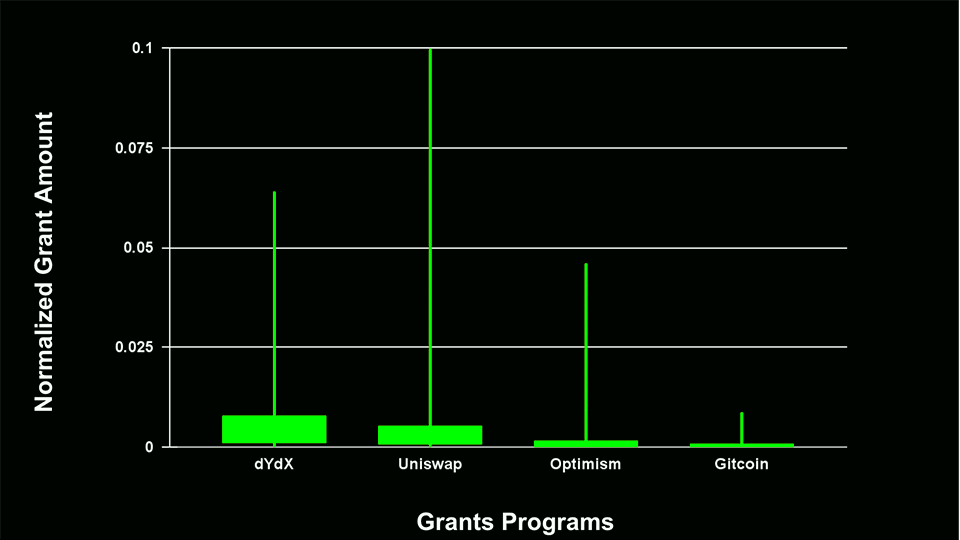
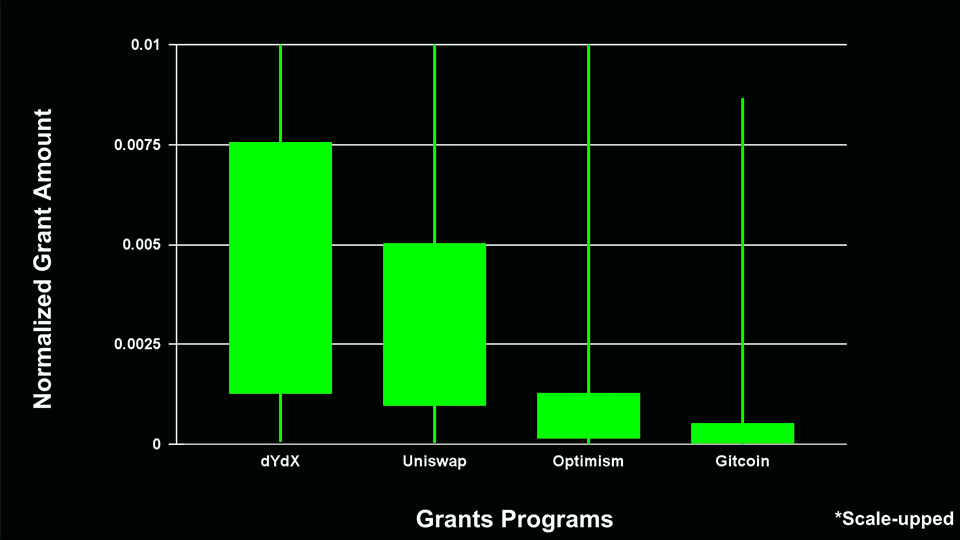
Actually, we have researched and published a detailed, quantitative comparison of different crypto grants programs to uncover and characterize differences among them. The study particularly focuses on the decision-making bodies and methods of various grants programs: Uniswap, dYdX, Optimism, and Gitcoin. We are categorizing them into “top-down type,” “bottom-up type,” and “QF type (algorithmic type).”
The study quantitatively compares the grant amounts and distribution methods across these programs. We can gain the result (hypothesis) that “bottom-up and QF types tend to distribute funds more evenly, with smaller variability and smaller grant amounts; in contrast, top-down types show greater variability in the amounts received by each grantee, with fewer recipients generally receiving larger grants”.
Proposal
I propose a contribution to conduct a deeper analysis of our research. In our previous study, due to limitations in funding and time, the scope of the investigation was restricted, making it difficult to perform a thorough and detailed analysis. With the contribution from Public Nouns this time, we can keep researching. This will enable the expansion of the study subjects and a focus on collecting and analyzing more detailed data. Additionally, this contribution will provide opportunities to collaborate with more DAOs and projects that operate grants programs, broadening the scope of our research. Ultimately, I believe that our research will offer valuable insights to the community, contributing to the design and implementation of more effective grants programs.
How does this initiative support Public Goods?
By examining the characteristics of each grants program, there is a potential to identify entities that can provide funding to projects that are currently underserved. Our research indicates that Quadratic Funding (QF) alone is insufficient. To effectively support a diverse range of projects, it is necessary to have multiple grants programs that complement QF. These additional programs would play a crucial role in addressing the funding gaps and ensuring a more equitable distribution of resources across various initiatives.
Also, we will arrange grants data of Public Nouns. A series of our research will serve as a compass for future funding decisions made by Public Nouns. This holds the potential to enable more effective funding strategies and the ability to provide financial support to areas that are different from those targeted by other programs.
How is it non-excludable?
The research and analysis we conduct will be published and made freely available to the entire crypto community, ensuring that anyone interested can access and benefit from our findings. This includes DAOs, individual contributors, and other stakeholders who can utilize our insights to improve their grants programs. By sharing our results openly, we ensure that no one is excluded from accessing the information, thus promoting transparency and inclusivity within the ecosystem.
How is it non-rivalrous?
The use of our research and findings does not diminish the ability of others to use it as well. Multiple DAOs, grants programs, and community members can simultaneously benefit from the insights provided without any depletion of the resource. Our data and analysis can be replicated and applied in various contexts without affecting the availability or quality for others, making it a truly non-rivalrous resource that enhances collective knowledge and decision-making processes across the crypto space.
Why does it need funding right now?
Immediate funding is crucial to capitalize on the current momentum and interest in improving grants programs within the crypto ecosystem. The rapid evolution of decentralized technologies and the increasing number of DAOs necessitate timely and relevant research to guide funding decisions. By securing funding now, we can promptly address existing knowledge gaps, provide actionable insights, and influence upcoming funding cycles to ensure more equitable and efficient resource distribution. Delaying the funding could result in missed opportunities to positively impact the community and enhance the effectiveness of grant programs in the near term.
Team Size
2-3 people (Research Lead, Data Analyst, and Assistant who we may hire)
Impact/Deliverables
Within 3 to 6 months after being funded Expanding Survey Scope: Broaden the scope of our research to include additional grants programs and DAOs, thereby providing a more comprehensive analysis. Deeper Analysis: Conduct a more detailed and nuanced examination of the data to uncover patterns and insights that were not possible in the initial study due to resource constraints. Publication of Report: Publish a detailed report within 3 to 6 months, summarizing our findings and providing actionable recommendations for improving grant program effectiveness.
Note: After 6 months (Future plan) though Making a Database: Develop and maintain a comprehensive database of grants programs to facilitate easier and more efficient analysis by researchers and stakeholders in the future. Practice of Grants Programs: Use the insights from our research to inform and potentially implement our own grants program, serving as a practical demonstration of our findings and recommendations.
Recipient Address
0x411f9a3cf8B761c0b29A7c18f0ca228C8E79BEB3
Amount in ETH
5 ETH
| Voter | Cast Power | Vote & Rationale |
|---|---|---|
 0xE048...d88846 | 6 | FOR |
 0xCF61...56c479 | 3 | FOR |
 0x6724...3a529d | 3 | FOR |
 0x5d36...7Cc1E2 | 3 | FOR |
 0xe3F4...aE0610 | 2 | FOR |
VOTE POWER
Proposal Status
- Thu August 08 2024, 06:57 pmVoting Period Starts
- Mon August 12 2024, 11:59 amEnd Voting Period
- Mon August 12 2024, 12:15 pmQueue Proposal
- Wed August 14 2024, 06:09 pmExecute Proposal
Current Results
1-FOR
31
2-AGAINST
N/A Tokens
3-ABSTAIN
N/A Tokens