
VDP-74 [Assessment]: Etheros Pharma - Jack Scannell
One-liner: Etheros Pharma is a preclinical biotech, pioneering a new small-molecule drug class that extends mammalian lifespan and neural healthspan (based on catalytic fullerenes)
Longevity Dealflow WG team
Scientific and business evaluation: Alexandra Stolzing, Sebastian Brunemeier, Matthew “Oki” O’Connor, David Wilson Shepherd: Paolo Binetti Other squad members: Laurence Ion, Tyler Golato Applicant (project lead): Dr. Jack Scannell
Simple Summary
Etheros is pioneering a new class of small molecule drugs, based on Nobel Prize-winning fullerene chemistry. The lead compound extends mouse lifespan, improves cognition in elderly mice, and has proven neuroprotective in a wide range of double-blind, placebo-controlled animal studies, ranging from a Parkinson’s Disease model in primates, via a familial ALS model in mice, to an asphyxia-induced brain injury model in pigs. The compounds’ novel catalytic activity makes them extremely potent, in head to head neuroprotection studies, versus conventional antioxidants that have previously struggled in human neuroprotection trials. The current raise, several hundred thousand dollars, will help Etheros improve its IP portfolio. It will also allow us to plan and cost, in executable detail, the optimal route to proof of mechanism in humans. Fresh IP and a firm plan to the clinic will help Etheros raise more capital on good terms in 8 to 10 months’ time.
Problem
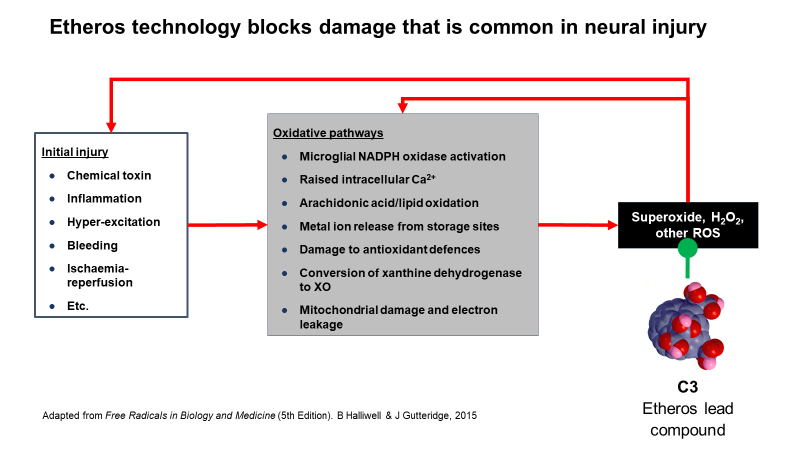
Oxygen-based metabolism is a double-edged sword. On one hand, it provides more energy than the wide variety of other metabolic chemistries. Hence all multicellular organisms respire with oxygen. On the other hand, oxygen’s high-energy chemistry destroys biological molecules. Consequently, all living things have a wide range of mechanisms to protect against oxidative damage, including the superoxide dismutase (and catalase) enzymes that our drugs mimic. Neural tissue is particularly sensitive to oxidative injury. This follows from neurons’ high metabolic rate, high lipid content, complex three dimensional structure, and from the fact that neurons do not regenerate. A wide range of injuries can activate a common set of oxidative pathways, which increase the concentration of superoxide, hydrogen peroxide, and other reactive oxygen species, which in turn compound inflammation and injury.
Opportunity
Our compounds mimic enzymes, superoxide dismutases and, to a lesser extent, catalases, that protect cells from oxidative and inflammatory injury. The lead compound has good brain penetrance, high oral bioavailability, and considerable safety data from long-term exposure in mice and primates. The technology can play in a wide range of therapeutic settings, some with huge commercial potential. One founder, Marc Feldmann, was responsible for the discovery of the anti-TNFs, which became the World’s highest selling drug class. He partnered with Dugan to commercialize her technology because he recognized a similar opportunity. Chas Bountra, an SAB member, was Head of Biology at GlaxoSmithKline and has experience of prior work in this general field. He understands the benefits of our novel catalytic mechanism versus conventional untargeted antioxidants. To quote Bountra: “Let’s be clear on why we don’t have effective treatments for [these kinds of neural] injuries. It’s not because we got the biology wrong. It is because, despite years of trying, neither big pharma nor biotech found drugs that had enough potency at the site of injury. We never found the right kind of chemistry. Etheros, at long last, seems to have solved the chemistry problem.”
We have a lead compound, C3, for which we already generated efficacy data in a wide range of animal models with mechanistic relevance to both rare and common human diseases. We see a tractable path to use in large markets; starting in niche indications that are mechanistically attractive, and where we can prove the therapeutic concept, before raising the large sums of capital necessary to fund trials in common diseases.


Intellectual Property
The bulk of the current raise will be invested to secure patent protection for new compounds, so we do not want to disclose details at this stage. Note that the Etheros has engaged experienced IP counsel and that the team has deep experience in IP creation. We are confident that we will secure robust IP. We are also confident that we have freedom to operate, unconstrained by competitors’ IP.
Relevance to Longevity
We have relevant data from several placebo-controlled double-blind animal studies. For a non-exhaustive list: Our lead compound increased lifespan in wild-type mice. Treatment started at 12 months of age. There was an 11% increase in median lifespan (mortality HR 0.59, p<0.004). In the same experiment, treated mice had better cognitive performance when aged between 23 and 26 months (measured via Morris water maze). Treatment also prevented the typical age-related decline in brain mitochondrial function and reduced measures of brain oxidative stress. The aged brain typically shows evidence of impaired proteostasis. Aggregates of the protein p62 are markers of impaired proteostasis and are also implicated in neuronal injury. C3, administered to mice from 12 to 17 months of age, reduced p62 aggregation in the brain.
Our lead compound is protective in a primate model of Parkinson’s, itself a common age-related neurodegenerative disease. C3 was initiated 7 days after unilateral MPTP-induced brain injury. After 2 months, treated monkeys had significantly better parkinsonian motor ratings and higher striatal dopamine levels. None of the treated animals developed any toxicity. In two studies, our lead compound was effective in a mouse model of familial ALS, another age-related neurodegenerative pathology.
Financing
Etheros is raising its first round of pre-seed / seed capital; several hundred thousand dollars. The main uses of cash will be: General corporate expenses. Specialist consulting advice on IP, medicinal chemistry, formulation, regulation, and IND-enabling toxicology and CMC. Synthesis of a stock of non-GMP C3, our lead compound. Synthesis and testing of novel chemistries to secure new IP.
Team
Founders Professor Laura Dugan: Dugan is the Abram C. Shmerling Professor of Alzheimer’s and Geriatric Medicine at Vanderbilt. Dugan is a former Paul Beeson Physician Scholar in Aging Research through the American Federation of Aging Research, The Hartford Foundation, and National Institute of Aging. She was also a Dana Foundation Research Scholar in Aging. She trained at MIT and Stanford. Dugan pioneered the technology that Etheros will commercialize during her research on neurodegenerative and aging-related diseases.
Professor Sir Marc Feldmann: An immunologist who Invented and developed the first successful monoclonal antibody therapy, anti-TNF, in his pioneering work with Remicade in the early 1990s. Remicade went on to sell over $7bn per year and the anti-TNFs became the World’s best selling drug class. Has been closely involved in commercial R&D ever since, and has founded several biotech firms. Marc was Director of the Kennedy Institute at Oxford University and is a winner of the Lasker Award.
Dr Subhasish Chakraborty: Chakraborty is an organic chemist with decades of experience designing, synthesizing, and testing novel compounds. He was a Senior Research Scientist at Carnegie Mellon University between 2004 and 2016. He has worked in Prof Dugan’s research group since 2016.
Dr Jack Scannell (CEO): Scannell has experience in drug discovery and biopharma investment. He led Discovery Biology at E-Therapeutics PLC, an Oxford-based biotech firm. He was Co-Head of European Pharmaceuticals & Biotech at UBS Investment Bank and Head of European Healthcare at Sanford Bernstein. He worked for drug industry clients while a consultant at the Boston Consulting Group. He studied medical sciences at Cambridge and has a PhD in neuroscience from Oxford. He is best known for his work on R&D productivity.
Frank Kneutell (COO / CFO): Kneutell has 30 years of management experience, growing early-stage and small-cap public companies. He has spent most of his career as a Chief Financial or Chief Strategic Officer. Most recently, he was the CEO of Unrivaled Brands, an operator of cannabis assets, where he grew revenue from an annualized $10 million to $100 million in six quarters. He has raised more than $300 million via venture, public equity and debt offerings. He has managed more than 15 mergers and acquisitions and has handled large-scale licensing transactions with fortune 50 companies. He holds an MBA from The Wharton School.
Etheros scientific advisory board
Professor Chas Bountra: Bountra is the Pro-Vice Chancellor for Innovation and Professor of Translational Medicine at Oxford University. He is also the Director of the Centre for Medicines Discovery. From 2008 to 2020 he Directed the Structural Genomics Consortium at Oxford. Bountra was Head of Biology at GlaxoSmithKline where he was involved in the identification of more than 40 clinical candidates across a range of therapy areas. More than twenty candidates progressed into human trials and more than five moved into late stage development.
Professor Lawrence Steinman: Steinman is the George A. Zimmermann Chair in the Neurology Department of Stanford University. He has experience in medical businesses, founding Neurocrine Biosciences, Tolerion, Transparency Life Sciences and Atreca. He held a fellowship in chemical immunology at the Weizmann Institute. He received the Frederich Sasse Award in 1994, the John Dystel Prize in 2004, the Charcot Prize in 2011, and the Cerami Prize in 2015. Steinman studied at Dartmouth and Harvard.
Professor Denis Choi: Choi is a pioneer in nervous system injury. He is Professor of Neurology at Stony Brook. He sits on the scientific advisory boards of several organizations, including the Cure Alzheimer’s Fund. He was the EVP for Neuroscience at Merck Research Labs. He was President of the Society for Neuroscience and the Vice President of the American Neurological Association. Dr Choi received his MD from the Harvard-MIT Health Sciences and Technology Program, and a PhD in pharmacology and neurology, also from Harvard.
Additional information
Selected publications Quick KL, Ali SS, Arch R, Xiong C, Wozniak D, Dugan LL. A carboxyfullerene SOD mimetic improves cognition and extends the lifespan of mice. Neurobiol Aging. 2008 Jan 1;29(1):117–28. Dugan LL, Tian L, Quick KL, Hardt JI, Karimi M, Brown C, et al. Carboxyfullerene neuroprotection postinjury in Parkinsonian nonhuman primates. Ann Neurol. 2014;76(3):393–402. Hardt, J.I., Perlmutter, J.S., Smith, C.J. et al. Pharmacokinetics and Toxicology of the Neuroprotective e,e,e-Methanofullerene(60)-63-tris Malonic Acid [C3] in Mice and Primates. Eur J Drug Metab Pharmacokinet 43, 543–554 (2018). Ali SS, Hardt JI, Quick KL, Sook Kim-Han J, Erlanger BF, Huang T ting, et al. A biologically effective fullerene (C60) derivative with superoxide dismutase mimetic properties. Free Radic Biol Med. 2004 Oct 15;37(8):1191–202.
Senior Reviews digest
Qualitative: Etheros’ compound, C3, has shown very promising results in improving lifespan and healthspan in rodents, in alignment with VitaDAO mission, as well as in Parkinson’s primate models. The scientific team is outstanding, they have well known scientists and very successful management. The company is backed by venture-capital. However, many untargeted antioxidants have failed in the past. The company has no current patent. And because no fullerene-based compounds have ever been brought into the clinic high burden is expected to get proof of safety/pharmacology of fullerenes. In summary this is a high potential /high risk opportunity, well aligned with VitaDAO’s objectives. Quantitative: The average conviction score was 3.9/5.
Highlights
- A novel catalytic mechanism and high potency in neuroprotection assays where conventional antioxidants, tested concurrently, are largely ineffective. In vivo efficacy data from a diverse range of neural injury and neurodegeneration models, all conducted as double blind placebo-controlled studies.
- A new mechanism for lifespan and neural healthspan extension in a well-powered mouse longevity model.
- Prima-facie evidence of safety from mouse longevity study and from chronic dosing in primates. Safety analyses so far include post-mortem histology of major organ systems, standard clinical bloods, ECG, etc.
- Good pharmacokinetics, with high level of brain penetrance, oral bioavailability, and clearance via urine and bile with minimal metabolism.
Risks
- Failure of novel chemistry. We believe that we can commercialize our lead compound, C3, in niche indications despite the lack of composition of matter patent protection. Method of use patents, orphan exclusivity, and other barriers to competition should be sufficient. However, to raise the capital necessary to exploit larger and more lucrative markets, we likely require new patentable chemistry. It is possible that the new chemistries that we plan to explore will work much less well than we hope.
- The choice of first-in-man indications. There is much we can do to mitigate risk in indication selection (e.g., knowledge of pathological mechanism, the predictive validity of screening and disease models, diversification across a range of disease mechanisms, a mixture of acute and chronic indications, etc.) but we cannot eliminate it.
- CMC (chemistry, manufacturing, and controls) requirements for an entirely new drug class. However Etheros has done some scoping work with a specialist manufacturer that has already produced small batches of the API at high purity, and believes that CMC hurdles can be met.
| Voter | Cast Power | Vote & Rationale |
|---|---|---|
 0x3F04...989Bd6 | 480,270 | For |
 0x5eC7...615170 | 378,277 | For |
 0x00a3...Ba8475 | 234,424 | For |
 0xAD1e...12dBb8 | 232,113 | For |
 0x5791...D37b10 | 177,429 | For |
VOTE POWER
Proposal Status
- Fri March 17 2023, 04:05 amVoting Period Starts
- Fri March 24 2023, 04:05 amEnd Voting Period
Current Results
1-For
2.073M
2-Abstain
9,419.665
3-Against
2,826.048