
The Wellbeing Protocol - Youth empowerment project
“I see the immense potential of this initiative to harness decentralised technology for the betterment of underprivileged segments of society and beyond” Aya Miyaguchi - Executive Director Ethereum Foundation
Background
DAOs, like Nouns, striving to use their resources “for good” often face challenges in channeling them toward meaningful, real-world impact beyond the Web3 ecosystem. We are creating a groundbreaking Web3 infrastructure of hyper-local community DAOs, designed to empower ‘real life’ disadvantaged / disempowered communities with resources in a way that is radically more efficient, transparent, and impactful.
Initially funded by the New Zealand government we have already built an easy-to-use, lightweight DAO inspired workflow / governance system (see how it works) that has now been successfully trialled with 15 communities in New Zealand, Australia, and the UK over the last 18 months.
We’ve learned that this system works particularly well with young people. Most recently, we completed our first youth-focused trial, where youth used the tool to propose ideas, vote on priorities, and decide how the money should be spent (see the case study personally funded by Aya Miyaguchi). They then took action to bring their projects to life. This approach gave them hands-on experience with leadership, decision-making, and financial control, while also creating meaningful impact in their community.
Nouns funded trials
To minimise end user friction, to date the platform has been built using traditional Web 2 technologies. We now want to go to the next stage and build out the Web 3 “back-end” infrastructure to allow funds (as stablecoin on a layer 2) to flow from a funder (e.g. Nouns) directly, transparently and incorruptibly to hyper-local community groups who would be empowered to use funds to address a predetermined focus area. Specifically, we want to use the new platform to fund two youth (18-25) groups to take action in the areas of:
- Youth mental health
- Environment / Climate change.
These trials will help us further explore how Web3 tools like on-chain funding and transparent decision-making can empower communities, build youth leadership, and deliver measurable social impact. Our goal is to give young people greater control over their future while showcasing how Web3 can support real-world, community-led change.
We see this as a huge opportunity to onboard new segments of society to Web 3, reframe Web 3 as a force for good for people outside the Web 3 ecosystem and shine a light on Nouns as one of the earliest projects to bridge the Web 2 / Web 3 philanthropy gap.
Please see Appendix below for our daft Litepaper that give for more information on “how” we are doing this.
Funding Request - US$110k
Our Web 2 based “product” is already in use ( in NZ, Australia and the UK), funded by grants from the New Zealand government, Menzies foundation and the founder of Xero.com (Rod Drury).
We are requesting USDC$110,000 in funding from Nouns DAO, which will be spent as follows:
- USDC$60,000 – Support for the core team and contributors to build the Web 3 infrastructure and optimising the existing community DAO governance tool. See work in progress architecture and mockups Appendix below.
- USDC$10,000 – Funding for a proof-of-good validator (see Appendix) to be trained and support the two communities.
- USDC$30,000 – Funds to be directly allocated to the youth-led trials, with USDC**$15,000** for each trial to support community projects and youth-led initiatives. Every $, from the funder through to the individual community member spending the money will be transparent to all stakeholders.
- USDC$10,000 - Publicity around the trials. This will include creating engaging content, targeting NZ and international journalists (TV, online and trad) who have previously covered our work, newsletters to all our existing supporters and creating innovative campaigns.
Activities / Milestones
It should be noted that we have a number of streams of work already in place (including supporting our existing trials, building relationships with potential funders and raising money) that we have allocated a separate budget for. The activities / milestones below specifically relate to the Nouns grant work.
Q1 2025
Activities
- Completion of the architecture and UI designs for the funder and validator dashboards
- Design and build the smart contracts
- Identify candidate proof of good validator and negotiations / contract agreements
- Legal and tax research
- L2 research and discussions with EF and core L2 teams (at this point likely either Optimism, Celo or Base)
- Impact measurement research
- Testing
Milestones
- Release of upgraded app
- Completion of funder and validator dashboards
- New validator relationship confirmed
- L2 selected
- Beta complete for testing
- Smart contract Audit complete
- Impact measurement strategy confirmed
- 2 Trials started with initial publicity.
Q2/3/4 2025
We have been working with marginalised community groups for over three years and are therefore aware of the difficulties in predicting timeframes - we have to move at the speed of trust. It is therefore hard to predict how quickly the trials will gain momentum. We will be working closely with all stakeholders to ensure success whilst evolving / building out the product and scaling the platform.
Benefit to Nouns
Supporting these trials offers significant value to the Nouns DAO community.
First, the publicity and media coverage surrounding the trials will highlight Nouns’ involvement in empowering youth through innovative Web3 tools. This can help position Nouns DAO as a leader in applying Web3 technology for social good. We believe that it will be easy to capture mainstream media attention in New Zealand and beyond (examples of previous project media attention include - TV Documentary, Business Desk, Devx, Crypto Altruism Podcast, TV3 News, Power to the People Podcast, Radio New Zealand, national newspapers)
Second, these trials will directly demonstrate how cryptocurrencies, smart contracts, and decentralized decision-making can be used in real-world settings to solve community challenges, providing a compelling case for how DAOs can drive positive change. By supporting this project, Nouns DAO can showcase its potential to make an impact in communities, build trust, and attract further partnerships.
Thirdly because our initial target market is youth led projects there is an opportunity not only to onboard them into Web3 but also get them involved in Nouns DAO. This has the potential to bring new energy and bids on Nouns. The younger demographic is more likely to be digital native already (Tik Tok, Fortnite, Roblox) making the jump into a DAO much easier.
And finally we will be open sourcing all our code if we receive this grant thus potentially giving others in the Nouns ecosystem ways to use what we have built. We are also keen to explore a Nouns fork.
About Us
The Wellbeing Protocol was founded by Mark Pascall, a New Zealand based crypto OG. Some of the highlights of Mark’s career:
- TVNZ documentary (New Zealand Geoblocked) covering Mark’s life and the early stages of the project.
- In 2017 brought Vitalik Buterin to New Zealand to keynote at conference he organised
- Co-founded Blockchain Labs
- Early partner at Metacartel Ventures
- Presented on Blockchain topics at two New Zealand government parliamentary select committees
- In 2020 created and ran the first University level course on DAO organisational design at Victoria University, NZ. Currently teaching course on DAOs as part of masters program
- Previously Executive Director of BlockchainNZ
- Co-authored “New Zealand: Unlocking Blockchain’s Potential” for the New Zealand government
- Presented at over 40 conferences in 6 countries on decentralisation topics (including recently at DevCon 24)
In 2020 he was joined by Benjamin Alder, a designer and social entrepreneur. There are currently two developers also working on the project and we are in the process of hiring two more.
Over the last 3 years the team have been researching, building and running trials across the world. Some of the highlights:
- In 2021 we trialled New Zealand’s first digital community currency (see also TV coverage)
- In 2023 were funded by the New Zealand government to apply an indigenous and Web 3 lens to reimagining the grant funding system (video created after first trial last year)
- Our participatory grantmaking tool aimed at government and philanthropy (see explainer video) has now been successfully trialled in New Zealand, UK and Australia
- Current funders include NZ Government, Rod Drury (founder of Xero.com), The Menzies Foundation
- Presented at DevCon and 10 conferences around the world (including Philanthropy Australia, London Funders, University of Singapore)
Appendix A - Early Draft Litepaper
Brand
We are going to move forwards with a more community friendly brand for the community facing interface (the app): Hum.Community. The Wellbeing Protocol will stay as the infrastructure provider and ultimately the protocol.
Stakeholders
To appreciate the mechanism and potential benefits it is important to first understand the four key stakeholder groups: Communities, Proof of Good Validators (Validators), Funders and The Wellbeing Protocol (TWP)
Community
The initial focus of this project is hyper-local place-based groups of people (typically 15-300) who share a common purpose / challenge. Our experience is that if these groups are given relatively small amounts of financial capital and the right tools/support they will work together to make a positive impact. We will refer to them as communities. For example:
- A group of 30 residents in a street who want to “regreen” and support a common area in their neighbourhood.
- 100 Refugees in an inner city suburb who want to help each other to prosper in their new country
- 30 youth in a marginalised community who want to make a difference to the environmental crisis
- 200 Residents in an african village who want to create greater resilience in order to get through droughts
Note that a person can be part of more than one community and community members are generally persistent (i.e. people don’t come and go) and set up to solve a continuous problem (i.e. not a single/specific project)
Typical community needs/desires:
- To improve their lives and build “alternative” forms of capital that actually support individual, community and environmental wellbeing
- To solve problems together (note the science around the health benefits of working as a community is strong)
- To have group autonomy / power over how resources (money) is allocated in a fair, transparent and easy way.
- To ultimately become less reliant on external sources of funding.
- To feel as though they can make a difference to seemingly impossible global problems such as the environmental breakdown or wealth inequality.
Proof of Good Validators
Proof of Good Validators (Validators) are existing organisations working in the community development space. Some characteristics of typical ideal Validators:
- They are existing registered charities / not-for-profits with many years of experience in the community development space.
- They have strong trust relationships with numerous traditional funders and the local community they operate in.
- Ideally they have experience running participatory grantmaking programmes
Typical Validator needs/desires:
- More efficient ways to do participatory grantmaking (i.e. empowering disadvantaged / marginalised communities)
- Less time spent trying to raise money (often competing with similar organisations).
- To maximise their impact.
- Regular funding to pay expenses (salaries etc) and support their communities.
Funders
Any individual or entity who wants to use financial capital to do good in the world. Our focus is on the increasing number of well resourced DAO’s who may want to do good in the real world using Web 3 rails however it could theoretically range from a teenager with $40 through to high net worth individuals, foundations, government social welfare agencies.
Note that within the existing social welfare and philanthropic / charity sector a huge amount of resources are devoted to trying to get money to the segments of society that most need it. Increasing numbers of philanthropists are moving towards “empowerment philanthropy”.
Typical funder needs/desires:
- To do good in the world
- Confidence that their money is being spent efficiently and having the maximum positive impact
- Full transparency on how money is spent
- The ability to “stream” money (and potentially adjust the stream based on realtime, impact information)
- Optionality: for example the ability to give, stake or loan money and the ability to decide if they want minimal interaction or a more hands on approach (potentially even being part of the community projects they are funding)
TWP
TWP would oversee the development and maintenance of the infrastructure and all assets needed (e.g. training resources and communities of interest). TWP would become a DAO, or Steward owned entity, i.e. an entity that instills two core principles into the DNA of a business: self-governance and profits serve purpose. These structures ensure that:
- Control over the entity is held by people inside the organisation or very closely connected to its mission and
- Profits are means to a purpose, not a goal in itself. Value created cannot be extracted. Profits are reinvested, used to cover capital costs or donated.
TWP needs/desires are:
- To build and support a thriving and growing community wellbeing ecosystem
- To generate enough income to grow and sustain a permanent team
- To create a financial or other incentive for early contributors / risk takers
- To create global positive impact.
- To serve the communities that use the infrastructure.
How it works
High level architecture
Figure A - High level money/data flow
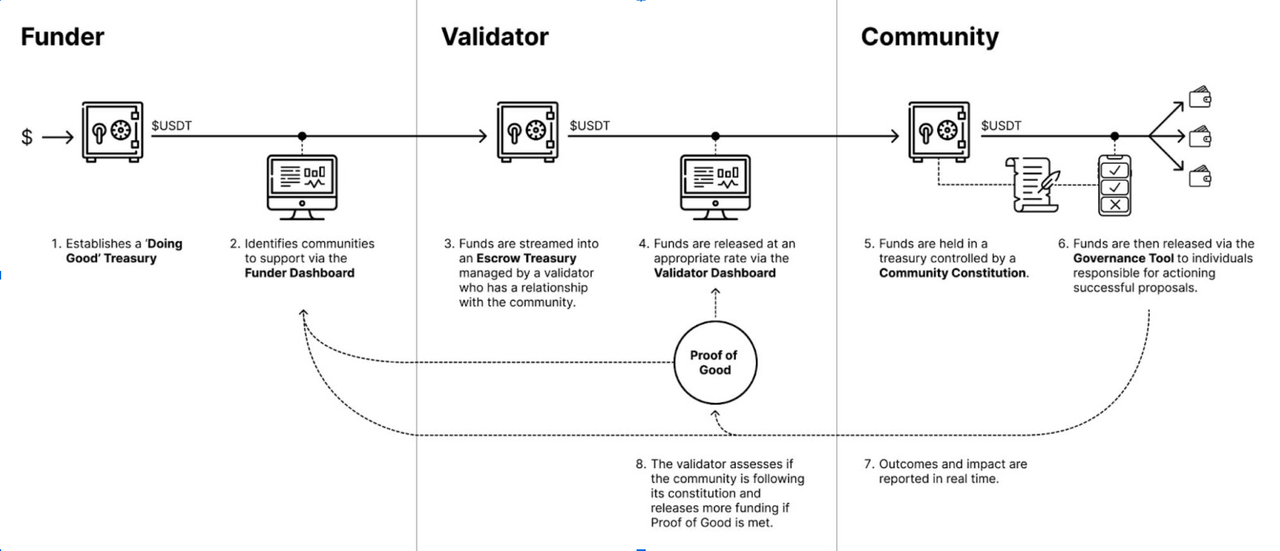
The basic concept is that we want to create an ecosystem of incentives that support the needs / desires of the stakeholders described above. Our goal is to create a world where:
- Community groups anywhere in the world (with the support of local Validators) would form to create a local positive impact. Some communities would form naturally (for example more capable groups in response to promotion around funds to support environmental projects) and some would be created by Validators targeting the most marginalised / underprivileged communities. Each community would create a short “constitution” document that described the purpose / values / rules of that community fund.
- Funders, via an easy to use dashboard, would deposit crypto funds towards any number of Validators and/or causes and/or communities. These funds would be converted to stablecoins and held in smart contract escrow accounts. A predefined % of funds (transparent and set by the Validator) would go to the Validator (e.g. 5%) and an agreed % would go to TWP (e.g. 2%). The funder dashboard would:
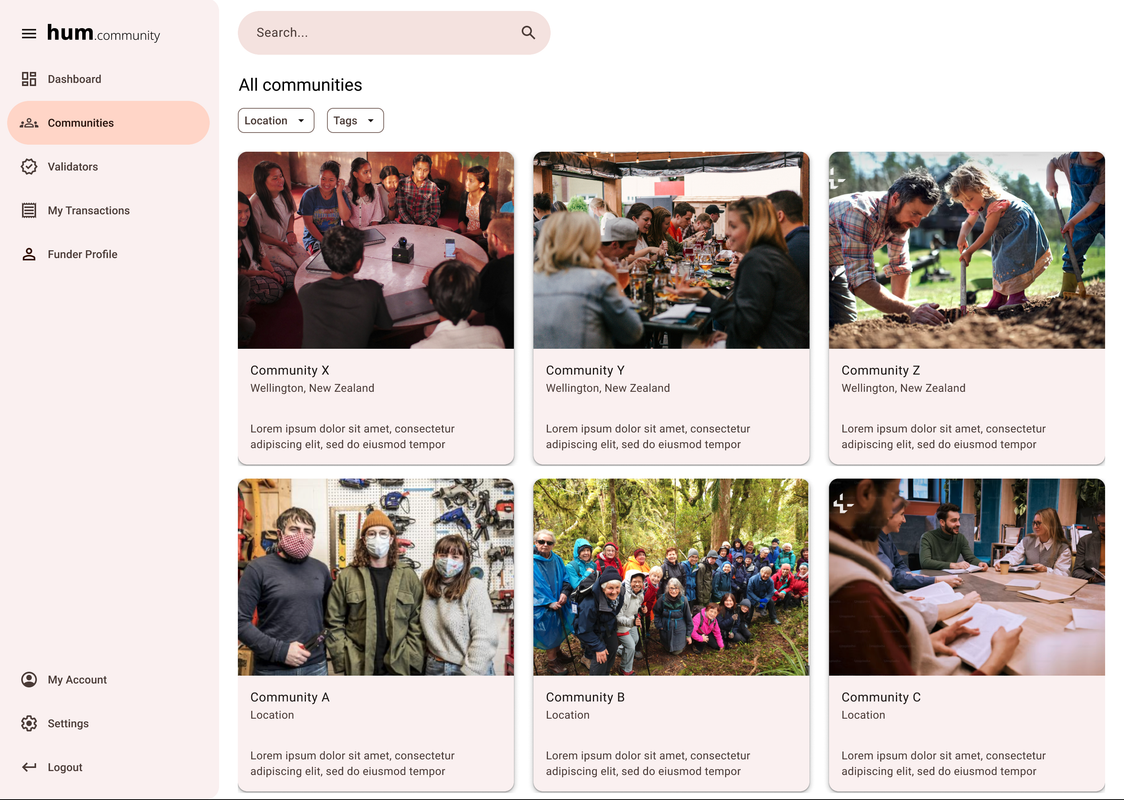
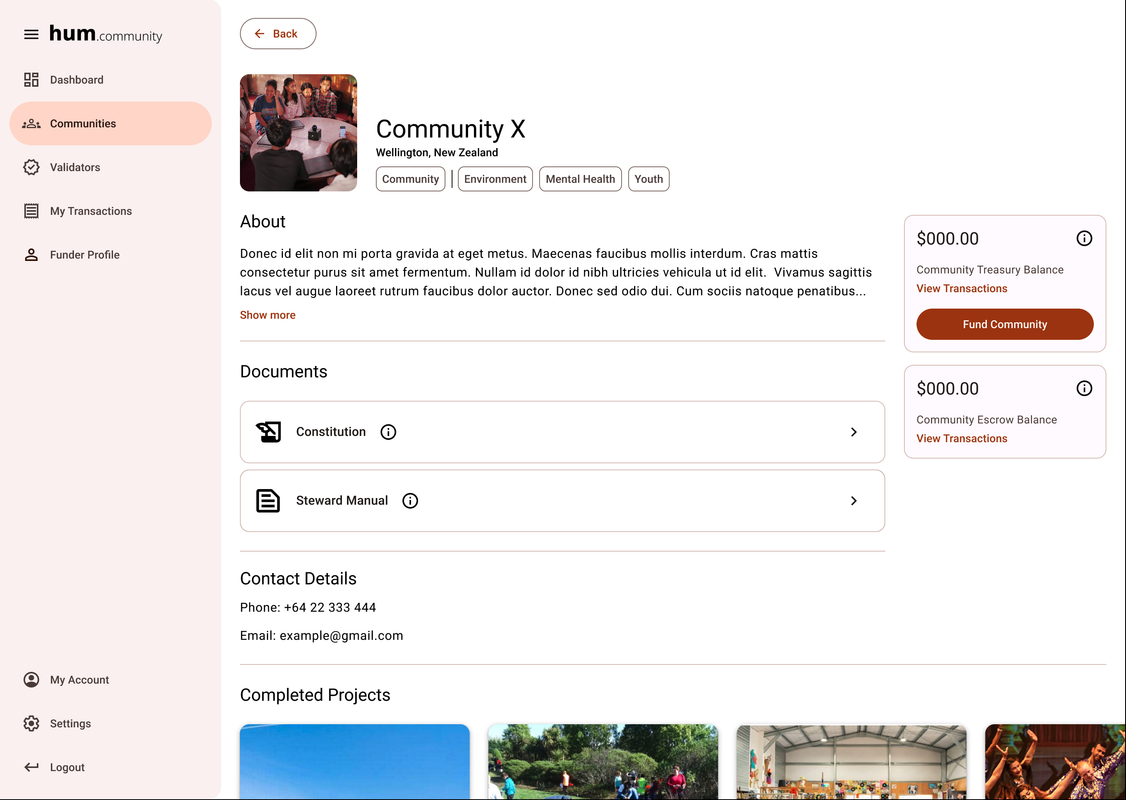
- Allow funders to easily allocate by location (e.g. fund in specific country, suburb etc) and/or validator (e.g. just fund these two Validators who they might know/trust) and/or cause (e.g. environment, children)
- Give real-time information summaries and drill downs of all payments (i.e. 100% transparency of funds)
- Allow funders to make regular payments or one up front payment and allow a “staking” option (where they would deposit funds that would be staked and the interest used to allocate to Validators)
- Validators would provide the communities with valuable expertise in helping to set up and run/support a growing number of trials for communities that need it most in their local area. Validators would also give funders subjective “proof of positive impact” (via stories and impact studies). Validators would be incentivised to do this as they want funders to continue to fund and more funders to get involved.
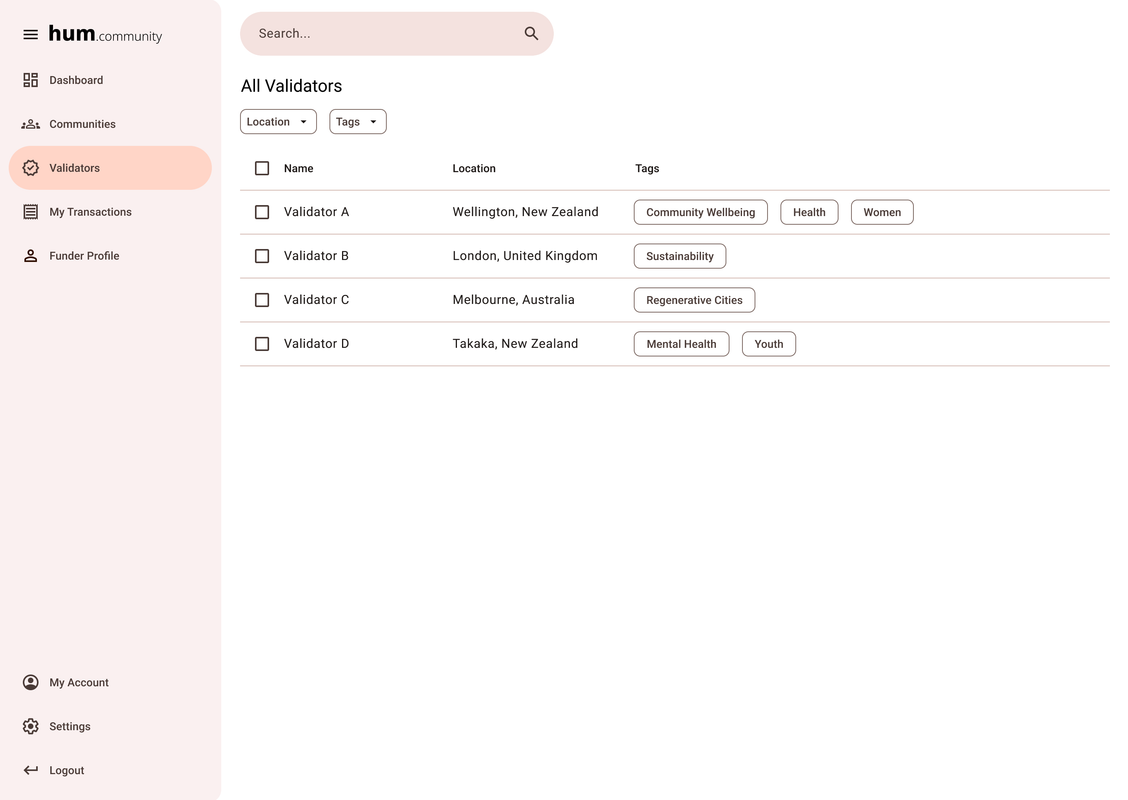
- Validators would have their own dashboard where they can see funds that have been allocated to them and they could easily set up and adjust streaming directly into community treasuries
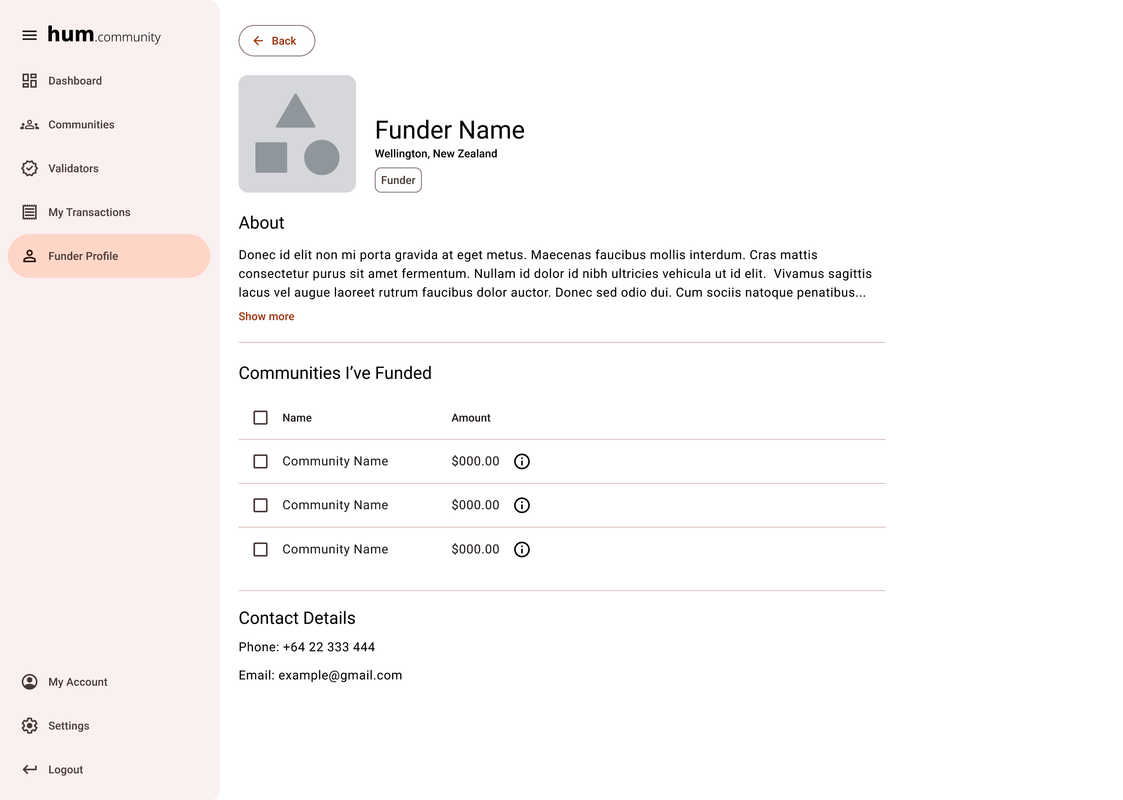
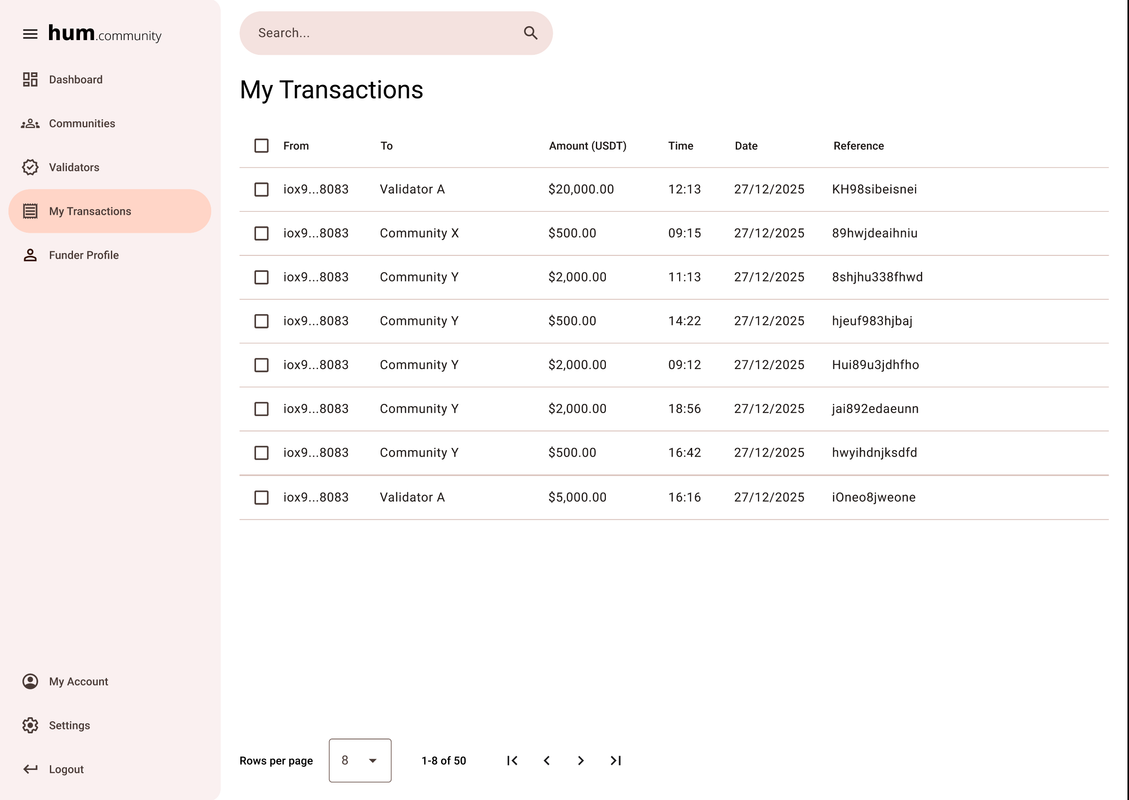
Funder / Validator interfaces
Figure B - Mockups of Funder / Validator Dashboards to be built
Community interfaces
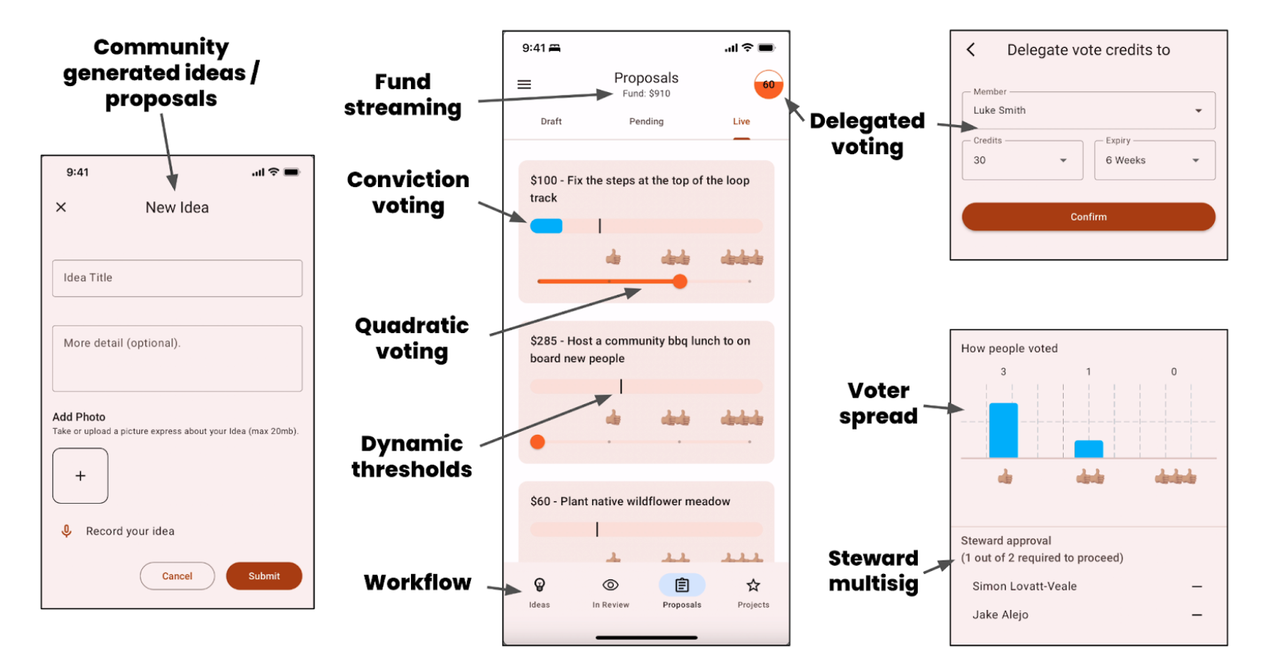
Communities would use a simple to use workflow / governance app that uses Web 3 inspired governance techniques (e.g. quadratic/conviction/delegated voting etc) to create an ongoing stream of proposals for microgrants that would go directly to individual community members. Note this part of the system is live and has been tested in 16 trials in three countries over the last 18 months via our participatory grantmaking app. Note that much of the inspiration for what we have built came from work by Jeff Emmet from Common Stack. See “Conviction Voting: A Novel Continuous Decision Making Alternative to Governance. Jeff is a supporter of the project.
Figure C - screen shots from existing live application being used in three countries.
Note
- When each community generated proposal reaches the voting threshold it triggers (via smart contract) a payment directly to the individual’s wallet. At that point we anticipate either giving the user a really easy way to “off ramp” into fiat or we set up a small network of key local vendors with wallets. This provides a huge opportunity / incentive to bring more people into Web 3. This will be location specific and require further investigation.
- Part of the community app process is to require reporting for each proposal. This information can be anonymised and provides end to end traceability for all funds for all stakeholders.
- Note that a fundamental principle of the project is that once a payment is in the community treasury, they are empowered to spend it how they like. They are incentivised to follow their constitution as Validators / Funders will get real-time information on their spending / reporting and could reduce further payments if they break the constitution.
Business Model & Strategy
Business Model
The current systems for funding / supporting the most marginalised / disadvantaged / vulnerable segment in our society is complex, bureaucratic and inefficient. It often involves numerous intermediaries (often competing for the same pots of money) and a lack of transparency. We believe this system can radically change this by offering a complementary system that is more efficient, transparent, resilient and community empowering. We have already proven that traditional funders are happy to pay for those benefits. Our business model is to take a small % of the funds going into the system. This might start high but reduce as we scale and the funding total increases. We are a not-for-profit and propose to be radically transparent with all our finances.
Our Approach / Strategy
Over the last 18 months we have been working with communities to build and refine the workflow/governance app interface and working with Validators (community development organisations) to build out the assets (e.g. training material, best practices etc) to support communities in different parts of the world. Our objective is to continue to organically grow out the number of Validators and trials (and therefore feedback) whilst building out the product features and moving onto Web 3 rails (Ethereum L2).
Once a community is engaged and trusts the system (as they have for all our trials) it give us a powerful foundation to build out additional functionality / tools in response to community feedback. So far we have had requests including community savings pools, volunteer coordination tools, community “voice” amplification tools, alternative governance mechanisms etc.
Once this is replicated thousands or millions of times the result is a highly resilient, decentralised network of grassroots changemakers. As we start to connect them, they start to become a powerful movement.
We will be following an Agile process with a two week sprint cycle.
The key parallel workstreams are:
- Partnerships - This will involve identifying appropriate potential Validators and funders in each country and building relationships - We will start with one developing country (we have a number of existing connections we are following up).
- Product development
- Storytelling - TWP is more of a movement than an organisation. We need to invest in the storytelling in order to attract the right communities, Validators and funders
- Fundraising - In the early stages, while we are scaling, we need to invest in raising money to both support our team growth and capital to start new community trials. Once we have got to a scale where we are sustainable we see an ongoing focus on building relationships with funders / DAO’s who want to fund local communities.
Once we have got to a scale where the business model and impact is proven then we anticipate building out a tokenomic strategy that allows us to scale further.
| Voter | Cast Power | Vote & Rationale |
|---|---|---|
 0xcC26...0f6Ed5 | 36 | AGAINST |
 0x73E0...1677Ec | 28 | AGAINST |
 0xA868...079E63 | 5 | ABSTAIN |
 0xc2d4...5Fe413 | 4 | AGAINST |
 0x13eE...7aDA33 | 4 | AGAINST |
VOTE POWER
Proposal Status
- Thu January 30 2025, 07:50 pmVoting Period Starts
- Mon February 03 2025, 08:25 pmEnd Voting Period
- Queue Proposal
- Execute Proposal

Current Results
1-AGAINST
91
2-ABSTAIN
10
3-FOR
1