
Arbitrum D.A.O. (Domain Allocator Offerings) Grant Program - Season 3
TLDR
- Previously known as Questbook grant program, we are seeking renewal for a third season
- This third iteration will last 1 year
- The vote is about renewing the program with the 4 historical domain (New protocols and ideas, Dev Tooling, Gaming, Education+Events) and adding a 5th domain (Orbit)
- Funding will be $1,500,000 for each of the 4 domains for a total of $6,000,000 excluding opex, plus a further $750,000 for the Orbit domain (half budget due to being experimental)
- JoJo will be the PM, Questbook will be the technological partner, and the elected DAs have been CastleCapital for New Protocols and Ideas, SeedGOV for Education, Community Growth, and Events, Juandi for Dev Tooling on One and Stylus and Flook for Gaming, plus MaxLomu for the Orbit track.
Abstract
The Arbitrum Domain Allocator Offerings Grant Program (D.A.O.) has operated for one year across two six-month seasons. The program has evolved and improved based on previous results, growing from its first season, which allocated $250,000 across four domains, to a second season with funding of $1,000,000 per domain.
We are now proposing a third season that would run for a full year, encompassing the existing four domains (Protocols, Education/Community and Events, Dev Tooling, and Gaming) with the addition of a fifth domain (Orbit), as per the snapshot vote. The vision is to create a modular program where new domains can be integrated over time based on DAO requirements and perceived needs. This new season will also improve tracking of grantee progress after funding and facilitate fast-tracking of exceptional projects into other DAO initiatives, such as Arbitrum Foundation programs and the GCP.
Questbook will serve as the technical partner of the program, offering their services through the Questbook.app portal.
Season 1 and 2 recap
Season 1 of the Grant Program was initiated through an RFC in April 2023, designed to serve four distinct domains: New Protocols and Ideas, Dev Tooling, Education/Community/Events, and Gaming. Following a successful snapshot and tally vote along with elections for the four DAs, the program officially launched in October 2023. The team consisted of JoJo, SEEDGov, Flook and Juandi as Domain Allocators, with Srijith serving as Program Manager.
The first season operated for six months with a budget of $250,000 per domain, totaling $1 million in funding, and implemented a soft cap of $25,000 per project. In April 2024, the program was renewed for Season 2 with the same team but expanded funding to $1,000,000 per domain. The soft cap was increased to $50,000, with proposals exceeding $25,000 requiring evaluation from two Domain Allocators.
Season 2 has now completed its fund allocation phase and will continue operating at reduced capacity for the next six months to oversee milestone completion and grant disbursement. Bear in mind that Season 2 results are partial from the first 6 months, and it will have its natural end in May 2025.
The following are the numbers so far achieved:
- Season 1
- Amount of projects approved: 67
- Amount of completed projects: 49 / 73%
- Amount of uncompleted projects: 8 / 12%
- Amount of abandoned projects: 6 / 9%
- Amount of withdrawn projects: 4 / 6%
- Amount of milestones approved: 207
- Amount of completed milestones 178 / 86%
- Amount of uncompleted milestones 23 / 11%
- Amount of funds approved: $997,793
- Amount of fund disbursed: $852,781 / 86%
- Amount of funds leftover: $87,512 / 8.5%
- Amount of projects approved: 67
Note: Uncompleted projects are those currently active but were either unable to complete their proposals within the last six months or pivoted to a different idea. Abandoned projects are from teams that weren’t able to operate in the market. Withdrawn projects are those that were approved but decided not to proceed with their grant.
While there was no specific timeline set, we feel Season 1 has come to its natural end, and we are in the process of informing teams and withdrawing remaining funds.
- Season 2
- Amount of projects approved: 140
- Amount of completed projects: 66 / 47%
- Amount of uncompleted projects: 71 / 51%
- Amount of abandoned projects: 2 / 1.5%
- Amount of withdrawn projects: 1 / 0.5%
- Amount of milestones approved: 506
- Amount of completed milestones 357 / 71%
- Amount of uncompleted milestones 149 / 29%
- Amount of funds approved: $2,841,027 / 92%
- Amount of fund disbursed: $2,067,492 / 67%
- Amount of funds leftover: $773,535 / 25%
- Amount of projects approved: 140
More details on the results can be found here.
Season 3: overview
In the last year, and potentially for the next year, the D.A.O. Grant Program has brought and will continue to bring the following value to the DAO:
- Introductory Grant Program: It fills the gap of Arbitrum Foundation grants (usually starting at $50,000, up to $150,000), serving as an entry-level program in our ecosystem.
- Transparency: All applications and judgments are available for everyone to read in the portal. Additionally, discussions with protocols are typically maintained in a public Discord with open access.
- Targeted Approach: The program has specialized in four specific verticals deemed key by the DAO
- High submission amount: between Season 1 and 2 we managed more than 700 proposals, approving around 200.
While these points have always been advocated and envisioned as the natural shape of the program, below is a non-comprehensive list of value propositions that has been provided so far through in the last two seasons of the program:
- Enable new teams and small builders to bootstrap their projects
- Enable mid and big team to prioritize certain deployment in Arbitrum
- Support Hackathon and Event winners
- Provide an alternative funding route alongside the Arbitrum Foundation or direct DAO proposals
- Support projects building upon targeted DAO initiatives
- Ensure builder diversity, enlarging indirectly Arbitrum mindshare for local builders.
A few specific examples of what we think can be defined as success stories:
- Season 2 has supported both the winner and runner-up of Arbitrum GovHack at EthCC
- Curia’s Governance Dashboard, initially rejected by the DAO, has been later approved through the grant program with a 20% cost reduction
- Pear Protocol, currently trading at $7.5M market cap with a $160M cumulative volume in 60 days in the perp space, received a grant to develop their API module for market makers
- Mountain protocol, rwa protocol having around $10M in liquidity in Arbitrum, has bootstrapped its activity in Arbitrum through a grant in Season 1
- Vyper, a language with an extreme mindshare in the Ethereum community, has seen support to their compiler in Season 2, which will help securing hundreds of millions in DeFi applications
- Applications like FairAI’s are building on top of initiatives such as LTIPP and STIP.b to improve the discoverability of projects with incentives.
In this new iteration, the DA program will last one year. After two six-month seasons with subsequent renewals, there is sufficient maturity in both the program and the DAO to extend it, reducing the burden on delegates for operational renewal and addressing issues such as gaps between seasons.
Funding will be proportional to Season 2, which effectively allocated $750,000 for each of the four domains for six months: for a one-year program, the funding for the four base domains will be $1,500,000 per domain, plus further $750,000 for the Orbit domain, for a total of $6,750,000 for the four domains excluding OpEx.
The grant structure will remain unchanged. Grantees can request up to $25,000 with a single DA review, and up to $50,000 with two DA reviews. Grants will be paid on a milestone basis, where projects must first complete the milestone, verify it with the DA, and then receive the corresponding portion of the grant. Only in exceptional cases, such as when milestone funds are essential for completion or in situations of economic distress, may the DA, at their discretion, release milestone funds in advance.
Upon completing KYC/KYB, grantees will have up to six months to complete their proposal. If they fail to do so, remaining funds will be retained by the program and either reassigned to new projects or, if the program has naturally concluded, returned to the DAO.
Upon proposal completion, grantees must publish a final report in the Arbitrum forum to inform the general DAO community about their project.
Three months after proposal completion, grantees must complete a survey and publish an update to their final report, aimed at tracking their success, foothold gained in Arbitrum, and adherence to or pivot from their original idea. As mentioned below, we will also introduce a rule for which 10-20% (precise amount to be determined after internal discussion with the new team) of the overall grant will only be released after the completion of this further step, pending evaluation of the specific DA. This will ensure that projects will comply in drafting the documents requested by the grant, and ensure a better retention of projects after completion.
Before the natural completion, a subset of projects will be internally selected by the PM and DAs for fast-tracking through a PM pitch into other ecosystem programs, such as the Arbitrum Foundation Grant Program or the GCP. While this won’t necessarily guarantee further grants from these or other entities, it will ensure exceptional protocols can continue their journey and expand within the ecosystem.
With these modifications, several gaps from previous seasons are addressed:
- Creating a checkpoint for approved proposals after their final milestone: This will enable better overall tracking of project outcomes.
- Integrating exceptional projects into DAO growth programs to establish a clear pathway for continued development within the Arbitrum ecosystem.
Program phases
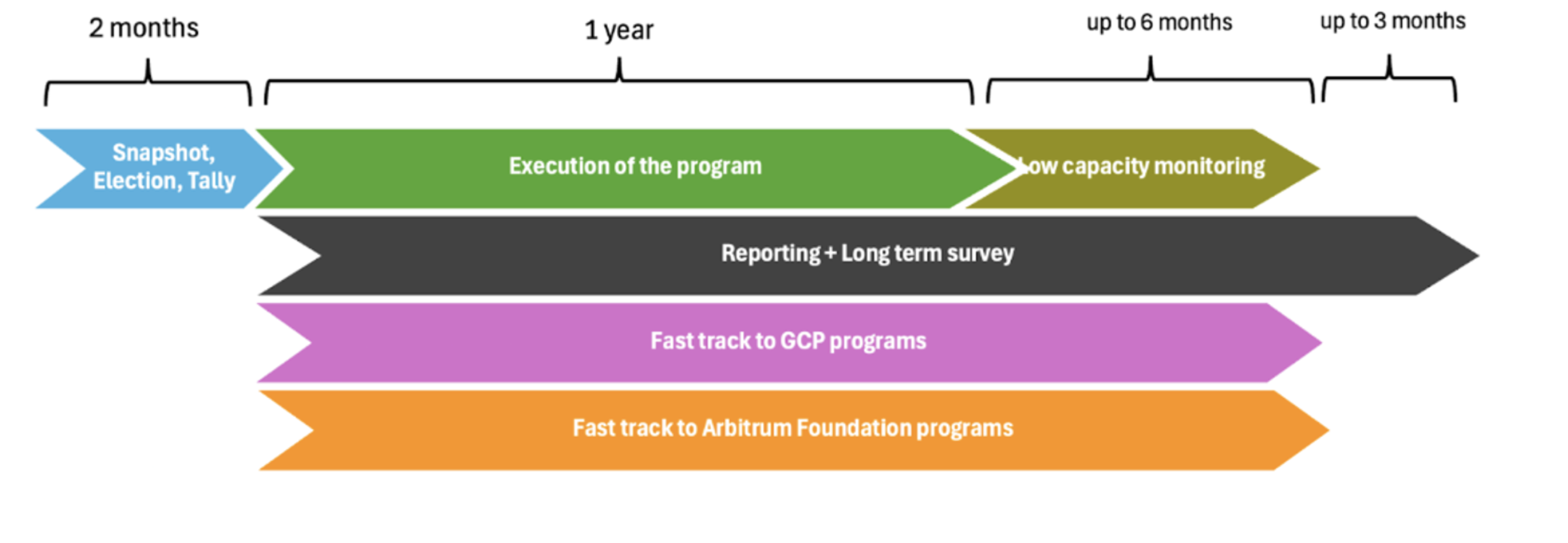 Excluding the initial phases of snapshot discussion, temp check on the proposal, candidacy for DAs, elections for DAs, and on-chain vote, the program is articulated in the following phases:
- A first 1 year phase: during these 12 months, funds allocated to the program will be assigned to DAs to the projects that will be evaluated as worth financing. During this phase, the green one in the graph, all the team will operate at full capacity.
- A second phase, at low capacity, lasting 6 months: this phase is also effectively already embedded in phase 1. During this 6 months we will assume that there won’t be any new fund to distribute from the main phase, and it will be a monitoring one. As stated, grantees, once approved and kyced, will have up to 6 months to complete their project. This means that projects approved, for example, in the last legal month of phase 1, will be able to complete their path up to 6 months after the end of phase 1. In this period, the team will work at low capacity, with a 20% cost.
- A third phase, potentially extending up to 3 months after the end of phase 2, related to the checkmark of projects after completion. If we consider a project that gets approved in the last month of phase 1, and needs 6 months to arrive to completion (so is completed in the last month of phase 2), we will necessarily have to place the checkmark 9 months after the legal completion of phase 1. Note: there is no opex coverage for this phase, since is effectively based on contacting projects, interviewing them likely with a google form and report in the forum, but only as said for projects that were approved in the last quarter of phase 1 AND that requires 6 months for completion (which is not always the case). This phase will be covered through the team which will have the goodwill of finishing to accompany projects in their path, and could potentially be resolved through the passing of the baton to a new team, or confirmation of the old team, in a season 4.
During all of these phases, there will be parallel communication phases related to
- the communication and reporting of the program in the forum: we need to, indeed, cover this for 12 + 6 + 3 months of the program
- the communication with Arbitrum Foundation: as stated, upon completion, best of breed projects will be pitched to the AF to have them continue their journey in the Arbitrum ecosystem, either through a grant, or marketing, or any other initiative that the AF might deem necessary, knowing that this internal pitch might not necessarily spark any follow up
- the communication with GCP, in the same fashion of the AF, once the fund will have their thesis and infrastructure up
- any communication with any other stakeholder or initiative that might be deemed relevant by the team or the DAO.
Domains
So far the program has run with four main domains:
- New Protocols and Ideas: A general bucket encompassing not only protocols, but also platforms, governance tooling, and other projects not specifically falling into other domains.
- Education, Community Growth and Events: A domain focused on physical events and educational material for Arbitrum.
- Dev Tooling on One and Nova: A technical domain oriented toward developer tooling and promoting Arbitrum Nova adoption.
- Gaming: A domain dedicated to web3 gaming and infra, web3 KOL gaming activities, and all video gaming-related projects.
All these domains remain pillars of our DAO today, even more so than a year ago. We are, for better or worse (though mostly better), the most accessible DAO in crypto, the first ecosystem to create a gaming fund of the size of GCP, and we have a technology stack that enables permissionless creation of L3s. Our ecosystem’s nature and soul, combined with the entry-level grant structure of this program and the diversity we inevitably achieve through it, provides strong justification to maintain all four domains. While most operational changes will be in the framework that moves projects from this program to others, we plan to specify domains based on relevant stakeholders’ feedback (Arbitrum Foundation, OCL, Delegates) to add more specificity and better tailored results.
Education, Community Growth and Events
The domain has seen significant attention, receiving the highest number of proposals in both seasons. Through discussions with Foundation members and key stakeholders, two additional focus areas have emerged where the grant program can provide value:
Events Focus:
- While continuing to serve the broader community, emphasis will be placed on amplifying Arbitrum’s presence in key global markets and events
- This will complement the Foundation’s growth efforts in specific regions such as, in random order, SEA, USA, LatAm and others
- The program will maintain an open approach, not limiting itself to these regions
- Regular coordination with the Foundation’s marketing department will help identify synergies between grantee proposals and events organized by the Foundation or other key ecosystem players
- The DA will be mindful about any request of grantees for presence of personnel of the Arbitrum Foundation in the events: while this can, in some cases, be accommodated, is not always possible.
Developer Relations:
- Increased focus on DevRel content for both One and Stylus
- Examples include, but are not limited to, video tutorials
- Goal is to foster technology stack adoption through expanded community-created educational materials
- This branch can partially overlap with and be covered/complemente by the Dev Tooling domain.
To reiterate: the domain won’t change its nature to only serve requests such as the one mentioned in the above examples, but might give in some cases more weights in the evaluation as there is value added in coordination with the broad ecosystem. The DA will still retain all its liberty of evaluation.
Gaming
The gaming vertical has gained increased attention throughout the year in Arbitrum, partly due to the GCP initiative. Key stakeholders, including OCL, have identified a primary need: Arbitrum Games should begin targeting the web2 gaming industry, creators and gamers.
While acknowledging that the grantee budget cap of $50,000 isn’t sufficient to attract web2 developers, we can broaden the domain’s scope by focusing on user acquisition through initiatives such as:
- Content creation for YouTube and TikTok
- Twitch streams
- Other KOL initiatives targeting the web2 gaming segment
- Grant proposal tuned toward KPI such as amount of reach, target impressions and others
- Independent publications like newsletters, blogs, and channels.
Important notes:
- The domain, while expanding, will still maintain its existing focus, which is financing teams to bootstrap or expand web3 games, web3 game related infrastructure and web3 gaming services in the Arbitrum ecosystem while expanding to include these new initiatives
- Success on the expanded scope will largely depend on selecting a strong candidate or team with specific experience and reach in this segment
- These requirements will be reflected in the election criteria.
Dev Tooling on One and Stylus
The Dev Tooling will undergo changes based on what the Arbitrum ecosystem has achieved, both technologically and in terms of PMF, in the last 12 months.
Nova, initially included in the scope, hasn’t seen the forecasted adoption. At the same time we have seen a big conviction bet on Stylus.
While it doesn’t make sense to exclude specifically Nova, it can’t be anymore one of the focus of the domain, which will be now called “Dev Tooling on One and Stylus,” incorporating the recent Stylus release. There shouldn’t be any consistent overlap with the current year-long “Stylus Spring” program for several reasons:
- Different funding amounts (up to $50,000 in DA program vs. potentially $200-500,000 for Stylus Sprint)
- Different application windows (always open in DA program vs. 8-weeks application period in Stylus Spring)
- Broader scope (Dev Tooling domain will likely continue to primarily operate on Arbitrum One).
The rubric will also be modified to put emphasis on Telegram’s tooling such as trading bots, fairly available in other ecosystems but less widespread in Arbitrum.
New Protocols and Ideas
The “New Protocols and Ideas” domain will remain the most general capture-oriented domain, as it has been in the last two seasons. Its inherent generality enables it to cover both classic ideas, like financing DeFi protocols, and DAO-specific needs like governance tooling. This domain will remain largely unchanged, except for maintaining constant alignment with the Foundation and other stakeholders on what is considered important and valuable when assigning grants. Additionally, there will be attention paid to the evolving narratives driving the broader market.
Orbit Chains
The successful snapshot vote confirmed the willingness to not only renew the program for a third season, but also enlarge the scope with a fifth domain, which will allow for the creation of an Orbit track.
The Orbit Chains domain will have the mission to:
- Enable Arbitrum protocols to expand their dApps to specific Orbit chains
- Deploy technological solutions aimed at addressing current user experience fragmentation
- Bootstrap solutions built on top of the 2024-205 Offchain Labs roadmap
The Orbit chain domain won’t cover the deployment of new Orbit chains, since this is a mission that is currently facilitated by the Foundation. This doesn’t mean that a project can’t have, in its milestone, the deployment of its own chain if that is part of a broader plan; but this can’t be the main focus of the proposal. The rubric and template will be drafted in detail with the elected team member, following the same process used for the other domain rubrics (1, 2, 3, 4), and will be ready by the start of the new season of D.A.O. grants.
Modularity
Several parties have expressed interest in adding new domains to the DA program.
While it wouldn’t be wise to expand the program further at this time, new domains might be needed at different intervals, as illustrated by the Orbit domain example, where the DAO might require a new domain program six months from now. For this reason, Season 3 is designed to be modular.
If the DAO votes to allocate capital for a new domain, it can be integrated into the current program by leveraging the existing infrastructure and Program Manager. The costs for adding domains would vary based on specific implementation requirements:
- For domains requiring no additional Questbook expansion and maintaining equivalent PM workload:
- Platform costs: Additional $1K/month
- PM costs: Additional $1K/month
- One new Domain Allocator required
Note that new tracks may operate with their own independent teams.
What does success look like
Evaluating success for an entry-level grant program can be challenging. The evaluation primarily focuses on three key metrics:
- Number of Grant Applications: The program has grown over the past two seasons with increased proposal submissions. We expect to maintain or exceed this level of interest. This KPI should be primarily compared to Season 2’s metrics, as Season 1 had both lower funding and a lower cap ($25,000).
- Grant Completion Rate: As an entry-level program serving primarily small and new teams, the risk of incomplete projects is higher compared to more mature programs. The completion rate will largely depend on DAs’ judgment in approving teams they trust to deliver. This metric should also be benchmarked against Season 2’s performance for consistent comparison.
- Long-term Project Sustainability: A new metric will track how many teams are still building on their original project and remaining on Arbitrum three months after grant completion. As this is a new measurement not present in previous seasons, we won’t have comparative data unless we retroactively measure Season 2 projects nine months after the natural end of that very season.
Resignation of DAs and PMs
In recognition that one year is a relatively long period for a DAO’s program, procedures must be established for cases where team members cannot complete their tenure. If a member resigns, they will assist with the transition, and the team will attempt to source a replacement. A snapshot vote will be held with two options: “Yes, proceed with the new member” or “No, hold elections.”
If approved, the new member will be onboarded to the team. If rejected, a standard election process will occur over three weeks (two weeks for candidacy, one week for voting). During any transition period where the former member cannot fulfill their duties, the current DAs and PM will temporarily manage the domain, including grantee collaboration, proposal evaluation, and milestone payments. Any compensation due to the departing member during this interim phase will be fairly distributed among contributing team members.
Budget
The RFC will request $1,500,000 for each of the four domains “New Protocols and Ideas”, “Education, Community Growth and Events”, “Dev Tooling on One and Nova”, and “Gaming”, and $750,000 for the “Orbit” domain, for a total amount of $6,750,000 excluding OpEx. The requested amount will be in ARB and, upon receiving by an address controlled by the Arbitrum, Foundation, will be then converted into USDC. Costs are listed below; it is worth mentioning that these compensations are based on a standard hourly rate of $100 per hour, with the commitment of DAs being around 80 hours per month, and the commitment of the PM being between 60 to 80 hours per month.
Questbook Platform: $60,000 total ($5,000/month for 12 months)
- Includes platform maintenance, improvements and bug management
- Synapse subscription for KYC/KYB of teams and grantees
- DocuSign subscription
Domain Allocator Compensation: $528,000 total
- $8,000/month for 12 months (five DAs)*
- Plus $1,600/month for 6 months during low capacity phase
Program Manager Compensation: $85,800 + 25,000 ARB
- 25,000 ARB released upon successful voting**
- $6,500/month for 12 months
- Plus $1,300/month for 6 months during low capacity phase
Legal Expenses: $30,000 earmarked.
Total operational costs: $703,800 + 25,000 ARB.
* If this on-chain vote is approved, JoJo, Juandi, SeedGOV, Flook, will forfeit any remaining payments from Season 2 at the start of Season 3.
** the 25,000 ARB will be delegated by** JoJo to** himself, and will be held as such for at least 180 days after the official start of the program.
Reporting
A more clear and standardized reporting will take place going forward. Specifically
- The PM will report, once per month, in the Arbitrum Governance call
- This type of reporting might change format and/or schedule: if the DAO is interested, for example, it could be a specific DA call, or it might fall into any of the new governance DAO’s calls that we could change or spin up in future
- The PM and the DAs will publish, once per month, a single unified report highlighting the status of the program
- All grantees, of all domains, at completion will have to publish a report in the Arbitrum forum
- All grantees will have to follow up the aforementioned report, after three months, with a survey prepared to understand the effectiveness of both the grant itself and the idea from the team, including but not only understanding if the team has decided to keep building in Arbitrum, expanding in other chains etcetera.
Operational changes
While in general there has been a very good reception of Season 1 and 2, there have been several feedback on how to improve the program moving forward. Addressing the gaps highlighted can be translated in three major areas of improvements.
Grantees Accountability
It’s clear that the DAO wants to have better results from the program, where better can be defined, among others, as more “stickiness” of teams that participate in the program, less frauds and scam which can be unfortunately quite common in low sized grant programs, and in general better results over time. For better accountabilities of the team these changes will be introduced.
- KYC: it will be mandatory for two people on the team. The signed document will have to match one of the identities of the KYC members who kyced. This will add friction on whoever tries to impersonate others
- Identity verification disclaimers: a clause will be included when filing for a grant, in which a team might optionally need to participate in video calls with the DAs with camera turned on. Failing to do so might lead to be rejected for the grant
- Completion milestone: to increase the incentives for grantees to complete their proposal and to complete both the final report and the followup questionnaire, up to 15-20% of the grant will be released 3 months after the final milestone, pending evaluation from the main DA which will take in account the success of the project. In this way, not only we will have the complete documentation from the grantee, but also we will guarantee that a portion of the grant goes to teams that effectively keep going with their activity 3 months after the release of their product.
Improvement in operations for the program and the Domain Allocators
There have been reports and feedback on how the DAs can better operate, and how the program could also improve through technological enhancements, to guarantee more quality in the program. The following will be implemented.
- More in depth guideline for due diligence for DAs: DAs are not in the business of being on-chain sleuths or OSINT researchers, and so far most of due diligence was just based on the single experience of the person involved. Thanks to Entropy, we have worked together on a set of easy to follow but comprehensive guidelines to do due diligence on projects. This will give more confidence on the teams in the program being genuine.
- Improvements in transaction execution time: to avoid bottlenecks in releasing grants, the structure of safes will be changed from the previous 2/2 to a 2/3 for each domain, with the main two signers being the respective DA and the PM, and a third backup signer being another DA. To increase security, any specific pair of DAs won’t be a signer of multiple safes.
- Improvement in how the Questbook platform generates the transactions: to mitigate and possibly avoid cases such as double transactions, we will require the Questbook team to improve the generation of transactions through their platform. Specifically, the message that is generated by signing a milestone directly in the platform won’t be encoded but will be in clear text for the DAs to have a further way to verify that the milestone queued is the right one, as well as some other improvements such as checking if the address input by grantees is formatted in the right way for the system to ingest it.
- Secondary ledger: the PM will keep a manually updated spreadsheet with all the transactions generated for each project.
Compliance to future DAO changes
Our DAO is evolving, and this is the first time we will have a one year long program. The current trend seems to indicate how several delegates might want to move toward a general standardization of oversight and reporting in Arbitrum. For these reasons, the following will be implemented.
- Standardized communication format implementation: while the PM will regularly communicate to the DAO on a monthly basis through the governance calls and with a unified report consistent across all domains, the communications might change in the future in case the DAO will agree on a general standardized format cross-program.
- Future oversight council compliance: as for comms, in case the DAO will agree on a general unified oversight unit, the program will adhere to it.
Steps to Implement and Timeline
- 06th of February: Starts of the on-chain vote
- 20th of February: end of the on-chain vote
- 1st of March: official start of Season 3 of D.A.O. Grant Program
Fund Management
The proposal is requesting a total 23,426,465 ARB tokens, equivalent to the $6,750,000 for the 5 domains and the $703,800 for OpEx, including 35% as buffer at the current price of $0.43 per ARB token. In the aforementioned amount is also included the 25,000 ARB bonus. The 23,426,465 ARB will be sent to the address 0xb9a05fCcc841202f1ee0dEee557C6abE5cbb6615 controlled by the Arbitrum Foundation, which will send 25,000 ARB to 0x4F685B29514eed0c9D929386E86D9cd81981118B and take care of convertion of the tokens in USDC up to the requested amount of $7,453,800. Any surplus fund will be returned to the DAO:Upon completion, funds will be split as per the following
- OpEx safe: managed by the MSS, it will be in charge of payment of suppliers and partners (Questbook, Synapse) and salaries
- Domains’ safes: managed by PM + DAs, one for each vertical with a 2/3 setup (the PM, the main DA, and a second different DA), will be linked to the specific domain through the Questbook website and will be used to disburse the grants. The safes will have the Zodiac Module for the clawback of funds.
| Voter | Cast Power | Vote & Rationale |
|---|---|---|
 0x7a45...502D26 | 20.712M | ABSTAIN |
 0x1B68...88eeaD | 18.155M | FOR |
 0x11cd...3e3A8F | 14.561M | FOR |
 Wintermute Governance | 12.836M | FOR |
 0xF4B0...91D8fA | 12.735M | FOR |
VOTE POWER
Proposal Status
- Thu February 06 2025, 04:09 pmVoting Period Starts
- Thu February 20 2025, 06:30 pmEnd Voting Period
- Fri February 21 2025, 08:31 pmQueue Proposal
- Execute Proposal

Current Results
1-FOR
130.177M
2-ABSTAIN
33.804M
3-AGAINST
20.19M